Categories
Book writing Personal Rambles

Three Books by Sixteen: What this Third One Taught Me

The Golden Heart, the third book I have ever written, is unlike anything else I have ever created. While my process for it has been much the same as it has been in the past, now it feels more streamlined. While there are many, many flaws in this first draft, I am proud of my little monster (I say that with all the endearment in the world). In this post, I will work to break down the major things I have learned from this first draft, what I did and didn’t do well, and my overall thoughts.

Synopsys of The Golden Heart

Montoya has been searching for the golden heart since he could read English. What started with childhood captivation fueled by support from his father has divulged into obsession. The heart, rumored to heal all that wears it, would be proof of an ancient society that has long since been lost to time. 

It would also be Montoya’s big break — a chance for him to cement his name in 1920s archeology circles.

When Montoya gets locked into a deal with the Devil, gets shackled to a partner who wants nothing more than riches, and when his arch-nemesis is biting at his heels, he realizes that archeology is much more than a dig site. Twist after turn, Montoya gets thrown on an unforgettable adventure through the jungles of South America.

Will he be able to find the golden heart and return to New York City in one piece, or will he be lost to time like all those who searched for the heart before him?

The Golden Heart is the first book in The Misadventures of Montoya and Rose series.

Stats

Started: July 14, 2021

Finished: November 24, 2021

Total word count: 60,587

The average number of words per day: ~ 456

Page count (8×11): 176

Number of chapters: 45

My NaNoWriMo Chart

My Major Strengths

Characters

The biggest thing I’m proud of with this book is the character arcs. And while right now, a day after finishing The Golden Heart, I can’t say if I’ve done it well, I most certainly put forth the effort to have all (or at the very least most) of my main characters change. Montoya and Rose have gone through an allies-to-enemies-to-allies-to-friends arc and it was a blast to write. 

I decided to include more side characters—make them matter—and I did it! I’m so proud of myself for hitting that goal that I set for myself. And now, I understand what other writers mean when they say that side characters can steal the show. I’ve fallen in love with so many of the side characters in The Golden Heart, and I feel the value of having appealing secondary characters — they make my novel richer (wow, really? No way!). 

I can’t wait to refine the work I’ve begun with these characters and see where they’ll go. 

Perseverance 

The Golden Heart was my NaNoWriMo project this year, and I not only hit my goal early, but I also finished the book (obviously). 

I changed my daily routine to include writing. I woke up at six, and by seven I would have my butt in the chair, drafting. By doing this, I have been able to consistently add in 500-700 words, even when it would turn out to be a hectic day. By starting my day out with my project, I would have it in the back of my mind, quietly working on it, while I focused on other tasks.

Oddly enough, I didn’t hit too many roadblocks while drafting The Golden Heart, which I attribute to my better understanding of story, but when I did, I shoved my way past them. No, I didn’t deal with them gracefully, I just put my issues into brackets and pretended to solve them. 

“Chapter 16” of The Golden Heart

My Major weaknesses

Pacing

The pacing of this novel has and will continue to keep me up at night. While drafting, it felt as if I was overwriting and adding in too much detail, but now I look back on it, I don’t think I added in enough… well, everything. There isn’t enough action, there isn’t enough “adventure”, there isn’t enough exploration; you know, the stuff that this book is about. 

I joke that I wrote a classic novel disguised as an adventure story with all of the conversations and navel-gazing in the prose. And while that can work, it’s not what I’m going for.

Traveling to get to the temple where the Heart is located takes up 97% of the book while being in the temple takes up maybe 2% of the book and the ending is 1%. Not the ideal story structure, I must admit. 

Beyond that, while I am happy that character arcs exist, they aren’t padded out throughout the story, and most of the development is jammed in at the end.

Hanging Threads

I brought up a facet of the worldbuilding to which I never brought resolution. A handful of side characters are left hanging in thin air. An entire side plot is just… unresolved. This is to be expected from a first draft, and a first draft that was written by the seat of my pants. Still, it bothers me. 

Gaps in my knowledge 

I had (and still have) many gaps in my knowledge about the 20s, which is a terrible thing considering the setting of the book. There is only one way to remedy this.

It truly shows in the way that the characters speak, the way that they get around, the way that they treat societal norms, hell, even some of their viewpoints. I am the most ashamed to admit that there are so many cut corners in terms of history, but I will do better about it in future drafts. 

This is the thing I feel the most ashamed about, but I know why I didn’t do more research before I began: I didn’t know what to research. Now that I have a better understanding of where and why the characters travel where they do, I can hone in on what I need to learn and fix it.

What I’ve learned

People are willing to listen to you ramble about your book even if they haven’t read it.

One of the biggest things that separate The Golden Heart from my previous novel writing projects is that I talked about it while writing. I never shared the entirety of the first draft, but I rambled on about it on my Instagram page, and people were incredibly receptive. It’s heartwarming for folks to seem just as enthusiastic about your work as you do. I know there are some major pitfalls to sharing a project this early, and I’ll just need to see where this takes me (and remain cautious).

I assumed that only myself and maybe one or two others would be invested in my characters, but I was wrong. So very wrong. And I’m thankful to be wrong!

Having genuine enthusiasm about your work, sharing that enthusiasm, and being earnest about your passions (in the right community) will generate love and support for that project. 

So much is gleaned from diving into your story

How effective pantsing is will vary from writer to writer (and even within the writer!), but I know for certain how much depth I can get from characters and setting when I simply start writing. It’s amazing. 

In my mind, when writing fiction, I need to get hands-on with the novel to get what I need from the story. 

Miscellaneous Thoughts

I adore the adventure, the banter, the action, and the dialogue between characters. I love Montoya and Rose with all of my heart, and I can’t wait to see where they’ll go from here! 

I know there is possible years’ worth of work ahead of me with this book alone. I am ready to face it—just not right now. Eventually, enthusiasm will ebb and grit will have to take its place, but right now I’m riding the high of the honeymoon. 

I’m thankful to get away from the grind of drafting a novel, and I’m looking forward to working on smaller projects. 

How The Golden Heart compares to my previous novels

It was less difficult than Heaven’s Hellions (you can read the post about my first book here) but more difficult than my Romcom (which I started and finished earlier this year). The adventure, historical, and magical components of the story put me out of my comfort zone, but not too much so that I floundered. At this point, I’m finding my groove with my drafting process. 

I think that it’ll be far more difficult to edit than my previous books. However, I can’t say for certain. 

Thank yous

As always, thank you Emily for being there through the highs and lows of The Golden Heart’s creation. Thank you for being a receptive ear, and excellent person to bounce ideas off of, and for being one of the greatest people I have ever met. 

Thank you, Meg (@meg.the.author on Instagram) for being an amazing cheerleader and friend and giving me an extra push when I needed it. 

Thank you, Athena (@author.athenagrey on Instagram) for always being someone I could rant to about my book, and for mutually wanting to stab Victor with me. 

Thank you to everyone who has supported my many, many posts about The Golden Heart on my Instagram page. Thank you for being invested in my work and cheering me on as I crossed the first draft finish line. Thank you for listening, thank you for being there, and thank you for your time. 

And thank you, dear reader (now this is a callout) for getting to this point on the post, and being invested enough to read to this point. 
Categories
Advice

Easy to edit but it’s a killer in your writing: Filtering

Originally posted to Instagram on July 11, 2021. Edits for clarity and grammar have been made.

What is filtering?

Filtering is when you add unnecessary words to your document explicitly telling the reader what the character sees, hears, feels, and thinks. It’s the most obvious in first person POV, but it occurs in third person POV as well.

There are specific words that indicate filtering such as: noticed, saw, heard, felt, knew, wondered, believed, decided, hoped, smelled, watched, (and many, many more). 

Examples of Filtering:

I see the birds flit from one branch to the other. I feel the humid, summer air wrap around me and I think about all the summers that came before this one. I hope that Grandma will be proud of what I’m doing… who I’ve become, but I don’t think she would be.

An example of filtering in the first person

He wondered about all the sorcerers that came before him—what they wanted him to be. He felt his stomach sink and the stave slip from his fingers. He heard it clatter to the ground, saw the oak wood split, and he tried to hold back a gasp and hot tears. He knew there was no going back.

An example of filtering in the third person

Here are the examples with the filtering bolded:

I see the birds flit from one branch to the other. I feel the humid, hot air wrap around me and I think about all the summers that came before this one. I hope that Grandma will be proud of what I’m doing… who I’ve become, but I don’t think she would be.

He wondered about all the sorcerers that came before him — what they wanted him to be. He felt his stomach sink and the stave slip from his fingers. He heard it clatter to the ground, saw the oak wood split, and he tried to hold back a gasp and hot tears. He knew there was no going back.

It’s super repetitive to read, right? It’s shocking how many times it crops up in those two short examples alone. Getting into other “good writing constructs”, you don’t want too many sentences starting the same way because it bores the reader (there’s more to it than that).

Now, let’s compare it without the filtering. 

Birds flit from one branch to the other. Humid, hot air wraps itself around me. This is just like all the summers before: same warm yet chilled with loneliness days that never end. Hopefully Grandma will be proud of what I’m doing… who I’ve become, but she isn’t.

He wondered about all the sorcerers that came before him — what they wanted him to be. His stomach sank and the stave slipped from his fingers. It clattered to the ground, the oak wood split, and burning tears pressed against the back of his eyes. There was no going back.

I kept some filtering in the second example. Why? Because the third person is removed from the subject inherently. Generally, when it comes to thoughts/thought processes of the POV character, you can filter or place the direct thought in italics. Don’t filter actions or sensory details (there isn’t a need for it!). However, to push myself I’m going to eliminate all the filtering from the second example. 

The disappointment of his predecessor sorcerers slammed down onto his shoulders and ripped the air from his lungs. What were they thinking? What were they going to do? His stomach sank and the stave slipped from his fingers. It clattered to the ground, the oak wood split, and burning tears pressed against the back of his eyes. There was no going back.

And still, the writing improves — there’s more details and a stronger sense of immediacy. Despite this being third person, we’re in his head. We feel what he feels. This dips into deep POV, which I adore.

Should filtering be used?

Like anything else in writing, it has its uses, but for the most part, ditch it. Filtering, at worst, alienates your audience and reminds them “hey, you’re not here”, and at best, it’s a drag and an eyesore. Sure, it’s grammatically correct, but it limits you as a writer. Most of the time you can cut it out and the sentence will be stronger for it. 

First person POV has little to no excuses for filtering. The sentence doesn’t work without the filtering? Reevaluate the sentence. The vast majority of the time, you can cut out filtering and come up with more impactful, creative ways to convey what you need to. Removing the filtering in the first example shows me a lot of weaknesses within it, which I won’t edit for the sake of comparison. But in seeing those mistakes, I can work to make the deeper edits that need to be made in order to improve it.

Conclusion

Surface-level filtering is easy to spot and eliminate and it instantly cleans up your prose. However, there is more to filtering that’s deeper and more difficult to explain (which I’m in the process of learning about). 

Want more examples and to do further research of your own? Check out Alexa Donne’s YouTube video titled “Filter Words and How to Fix This ‘Telling’ Problem”. 


To be frank, I am heavily biased against filtering because it is one of my writing and reading pet peeves. Filtering annoys me because it’s such an easy fix but it clogs up a manuscript like nothing else. Once you see it, you can’t not see it.

Thank you for reading, and hopefully, you found this helpful.


Original Instagram post
Categories
Advice

Avoiding Writing Burnout

As we near the end of November, many of you will be feeling a little frazzled and burnt out on your projects. But with plenty of time left to go, you need to try and avoid burnout as much as you can. 

As some background, this past summer I hit some of the worst burnout I’ve ever had with writing; right at the beginning of it I finished the book I had been drafting, and I had no clue what to work on next and I had no motivation to actually work on another project. Having pushed through that, I’ve come to some realizations. 

1: Consistently consume media while writing

This is one of my biggest mistakes, and it always leads to a “dried up” creative well. I don’t read as much as I should, I don’t watch any TV shows or movies, thus, I’m not studying stories. 

It’s so important that you take the time to read/watch other media as you write — not only so that you don’t run out of ideas, but also because it allows for you to study story. Most of our knowledge on the subject is intuitive, and in order to continue learning, we must continue studying. 

Take some time out of your day to pick up a book, or read a poem from a collection. Maybe listen to an audiobook while you do chores. Find the time to squeeze it in during your hectic schedule. 

2: Don’t force yourself to write when you’re feeling sick of it

Or, if because of Nano you have to, break it up into smaller, more manageable chunks throughout the day. Listen to your “heart” when it’s telling you it’s tired. Sometimes, yes, you need to persevere, but there are times where it’s better to cut your losses and rest. If you can’t tell if it’s one of those times where it’s better to push through, set a ten minute timer and do a writing sprint. How do you feel after doing that? A lot of the time you’ll want to continue, but if you don’t, then simply don’t continue writing.

3: Schedule times to not write

I tell myself that I don’t need to write in the evenings, however, I need to write in the mornings. An extension of this tip is to have a writing schedule, but so much of the time we’re focused on when to write that we neglect how important breaks are. 

You can prevent a crash-and-burn burnout by allowing yourself one or two days out of the week where you expect yourself to not write, or write very little. It’s like knowing you have a weekend, but with writing. 

4: Don’t guilt yourself over not writing

Life happens. Motivation ceases. Brain does that thing where it’s unhappy. Whatever the case, beating yourself up over not doing a very time-intensive hobby is not going to make you want to do the time-intensive hobby. Take a deep breath.

And I’m here to remind you that if you haven’t written recently, that’s okay! You’re still a writer and you’re still doing amazing, wonderful things.

5: Do things that are adjacent to writing

One of my favorite examples of this is drawing my characters. Do something that’ll make you think about your WIP without having to expressly work on your WIP. Or, you can go for a walk, workout, generally do something physical to get yourself out of Writing Mode™ while you brainstorm ideas. 

6: Journal your feelings about the project. 

I do this via social media, but putting this in your personal journal or keeping it separate really helps. If you have a writing buddy, chat to them about all your feelings about the project. I find that when I’m feeling unmotivated, or I’m on the verge of burnout, seeing the passion I have for my project fuels me to keep going (or at the very least spite the honeymoon phase Jay). 

7: Don’t take yourself too seriously 

Tease yourself about your mistakes, pretend you’re a bestselling author giving an interview about your project, make memes/jokes about the characters/plot of your novel. Whatever you do, make it fun so that you don’t feel like you’re carrying the weight of this project on one shoulder. 


Thank you for reading, and hopefully you found this helpful! No matter what you do, know that I’m proud of you and you’re doing so much better than you think you are. 

Categories
Personal Rambles

Welcome Back, Me.

Intro

On October 31, it’ll be a year since I started this blog. I had big plans: grow this platform along with my Instagram, consistently document my writing journey, share short stories, advice, the lot of it.

And here I am. The last time I updated on here was ten months ago with a shoddy post about goals or something equally as lofty. Then, this site started collecting digital dust.

I was amazed whenever I received an email that someone, somewhere, for some reason, decided to like a post. For a minute, I would go, “why?” and ignore the notification. So, in the past ten months the only time I thought about this site is for a collective three seconds.

At least I’m consistent.

Why I left

It wasn’t intentional.

I got busy with life and this fell to the bottom of the priority poll, and I forgot about it.

It would be so much cooler if there was some epic tale about how I was fighting a clone of myself, or an evil robot locked me out of this account, or that I needed to shed all aspects of my former identity because I needed to go into the witness protection program.

Nope, I’m just a teenager. Sorry folks.

Where I’ve been:

  • School
  • Growing my Instagram platform
  • Writing (I’ve written another book in the time I’ve been away! It’s the Romcom I vaguely alluded to in the past)
  • Wasting away my youth watching YouTube
  • Whinging about the YA book I read
  • Letting my cat in and out of my room

Why I’ve Returned

I’ve found my Instagram niche in the teen writing community. Sometimes I give advice on how to write X, Y, and Z, or I share very short snippets of my writing. Instagram has a ten slide limit for a single post, and that means I need to cram all the information I have into tiny font.

I’m sick of it.

I want people to be able to read what I create without straining their eyes. I want to go more in-depth with my opinions and advice. I want to share my short stories.

However, I realize that the demographic that reads and utilizes WordPress as a blogging platform aren’t my original target demographic, and that’s okay. Maybe it’s time I diversity who gets exposed to my work because, well, if it’s quality, it shouldn’t just appeal to teenagers.

Expectations, goals, and where to go from here.

I will continually work to make this website as visually appealing and substantial as I can.

I will post some of my beefier Instagram posts as blog posts so that those of you who aren’t here from the social media platform can get up to date on what I’ve been doing.

I will, of course, continue to post to Instagram — some content is better suited for that platform anyhow — but I will work to create original posts for this website. I will share original fiction that isn’t suited to Instagram’s platform. I will do whatever I feel like.

This blog won’t blow up. Hell, I don’t expect anyone to read this post (if you are, here, have a cookie and not the data tracking kind), but I want this to be here for me. It has been so nice to look back on my old posts and see where I was about a year ago in my writing; to laugh at myself and to nod in approval the things that Past Jay has accomplished. In many ways, this website feels more substantial than an Instagram account. If I ever turn this into an Official Author Website, then I hope my readers will be able to look back at where I came from and say “I’m glad he doesn’t write like that anymore, seesh.”

Conclusion

I’m not going to promise that I will be consistent in my posting, but I am going to promise to try.

I’m excited to continue this journey with you.

Thank you for reading and I hope that you find a bucket full of marshmellows later,

~Jay Montague

Categories
Book writing Personal Rambles

2020, Writing, and Me

Do you remember how we all had such high hopes for a year with such a swanky number? This past year was disastrous for many reasons, but it pays no fool to focus on the negative.

There were only two obvious things that weren’t terrible for me this year, and one of them was my success with writing. The other is too personal for public platforms. Anyhow, I have written a full novel and have made significant progress with another (granted, it’s a rewrite of the completed novel. I’ll get into it). I’ve also started taking my experimentation with this blog and Instagram seriously, and I have… hopes for them both.

Some reflection about my novel

I fully expected to feel like I have gained some kind of power and knowledge with having completed the first draft of a book, but I feel just as I did before. But there’s no doubt in my mind that I’ve significantly improved as a writer in this past year.

Not only on a basic prose level but also on an overarching structural level. Novels are so intricate and if one thinks about it for too long, it gets far too overwhelming. But that means that there’s always something new to learn; that your progression has no real reason to plateau. 

I also learned that I can write a book. I wrote a book! Most can’t say that. Knowing that it is, indeed, possible for my peanut brain to do such a thing fans the flames of my ego. I best be careful about that… That confidence has inspired me to rework and rewrite my first book.

The seemingly insufferable task of rewriting a book is daunting, and it’s a sure sign of failure, but I was going to fail somewhere, so it might as well have been with a draft. The long and the short of it is that I found the story I was meaning to tell only after I fumbled around with a crapshoot.

I have a new focus. I made an outline, and I have pumped out 15k words in a week.

Goals concerning my novel writing

I want to go through the revisions and begin the editing stages of a novel this upcoming year. I want to push myself further into the process than I have ever gone before, and I wish to enlist the help of beta readers with my project.

There is also a series of short stories in the works right now. My hope is that I will be able to start releasing my new project by or in the summer. I will talk more about that project when I officially announce it — for now, you must wait in suspense (I’m sure you’re so very invested in a lofty promise of a project that you must find a way to settle yourself. I recommend cold water).

As far as long term goals, and how I want to share my work with the general populous, I haven’t the faintest idea. Will I try to go the trad route? Will I go through a more professional means of self-publishing? Shall I just post to an open platform site such as Wattpad? Who knows. 

Goals concerning my social platforms

I doubt that I’m going to reach massive heights with this here blog and my Instagram. However, I’m not going to focus on numbers because they’re too finicky and have a nasty tendency to mess with one’s head.

Rather, my goal here is consistency. I want to push myself to post regularly on both platforms. I’m going to try a new system of posting that seems to work for many others and I hope will work for me. I want to be able to gaze upon a backlog of quality posts. I won’t fib and say numbers are meaningless to me — I’m not that egregious of a liar. Nay, I’m curious to see what frequent, quality posting will do. How much will I grow? Must I pay to play (in this capitalistic society, yes. However, how far can I push it before I must pay to play? Probably far less than I’m willing to admit). 

I also wish to improve upon concise works such as short stories and blog posts. I want to become a better opinion essayist — which will do nothing but help in the grand scheme of my academic career. It’s also important to me that I have something of a backlog of my work (as embarrassing as it may come to be) to show where I have dug my roots into and grown.

A backlog of free works that are representative of my style and genre preferences may help with growing a readership. Besides, one is never too young to herd readers and use them as cheap bait to earn a profit (I am nothing if not a hypocrite; it’s one of my many dazzling talents). As in, I enjoy following authors and seeing where they’ve come from and how their work has evolved, so, why not do it for myself?

Goals concerning revising and editing

I touched upon this briefly in the novel section, but I wanted to dedicate an entire space to it. I have very little experience with revision and editing for I have yet to make it that far into any of my long-form works. As a more experienced writer than I has said,

Good writing is rewriting

So many old white men that the internet can’t decide who got there first but it certainly wasn’t me so don’t go turning some greasy eyeballs looking for plagiarism.

I may have a book, but that doesn’t mean it’s close to being a great or even good work. It simply exists as a dumpster fire on my Google Drive — the warmth of which heats up the left for dead manuscripts I have piled in there. 

Conclusion

It’s apparent that none of these goals are what one would call concrete. However, that just means that Future Jay can determine the threshold for success and failure. The scoundrel best be in a pleasant mood when he reflects upon these goals. 

Categories
Uncategorized

The End of a (short) Era

This post is mostly a way for me to mark when I’ve implemented certain changes to this site. It’s four days away from the new year, but I might as well start here and now lest the weight of ‘2021’ gets to me.

I want to do better with this blog and my overall online social endeavors. I need to utilize some of my self discipline (yes, I have it. It’s not much, but it’s there) and try to make this a challenge that I’ll succeed at.

Perhaps the face of an older and wiser Jay will sit here and shake his head my naivety, or he’ll gloss over this post all together. I wouldn’t put either past him.

I’ll make a more comprehensive post about my ups and downs relating to writing in a couple of days.

Much thanks if you wasted your time reading this.

Categories
Book writing Personal Rambles

New Book Giddiness

I am a lier and I am a fool. When I walk, the bells attached to my jester’s hat jingles. Not only am I the a clown; I’m the whole damn circus.

The dramatics aren’t called for.

Okay, you’ve waited two paragraphs for my point: I’ve started writing a new book!

I said that I would take a break, take a KitKat or whatever.

Lies.

The lot of it.

My brain is just in this mood for novel writing right now, and it’s fantastic! And I know that the Muse will eventually leave me in a nasty divorce (who keeps the kids?) and I will have to work off of good habits and pride.

I was so lost down this spinning spiral of my other project that I made myself cross-eyed. And considering that I don’t have an outline, only like, the vague idea of a climax and whole bunch of cute scenes and dialogue, I’m hoping for the best.

That means that I am in the Disaster Draft™ (thunder booms in the distance) stage of my writing. Not worth being called a “zero draft” nor the honor of a first draft. Nay. It doesn’t even get a number it’s so monstrous.

What is this new book about? you may (or may not) be asking.

That’s a good question. I uh… I barely know. All I got is that it’s a contemporary YA romcom.

There could be ghosts (I love me some ghosts), it’ll be a little meta, and a whole lot of fun.

I don’t want to give away the core concept I’m working with mainly because even core concepts can be subject to change while I frolic around in the Disaster Draft™.

Fun fact: I even have a little blue notebook for this new project! And I’m brainstorming working titles for it.

Point being, I’m going to ride this high while it lasts. I’m going to jot down everything that comes to mind, and I’m going to have fun. I’ve already made myself laugh so many times, and that’s exactly what I need.

There’s something magical about writing a new book, so I’m going to try and preserve this glee in a little glass jar, and use it when Disinterest rears its ugly head (the plan being to chuck the jar at it and see what happens).

I better like revising or else my thoughtless ass is doomed.

Thanks for reading, and I hope you stumble upon a lucky coin later.

~Jay

Categories
Book writing Personal

I’ve Just Finished Writing My First Novel at Fifteen

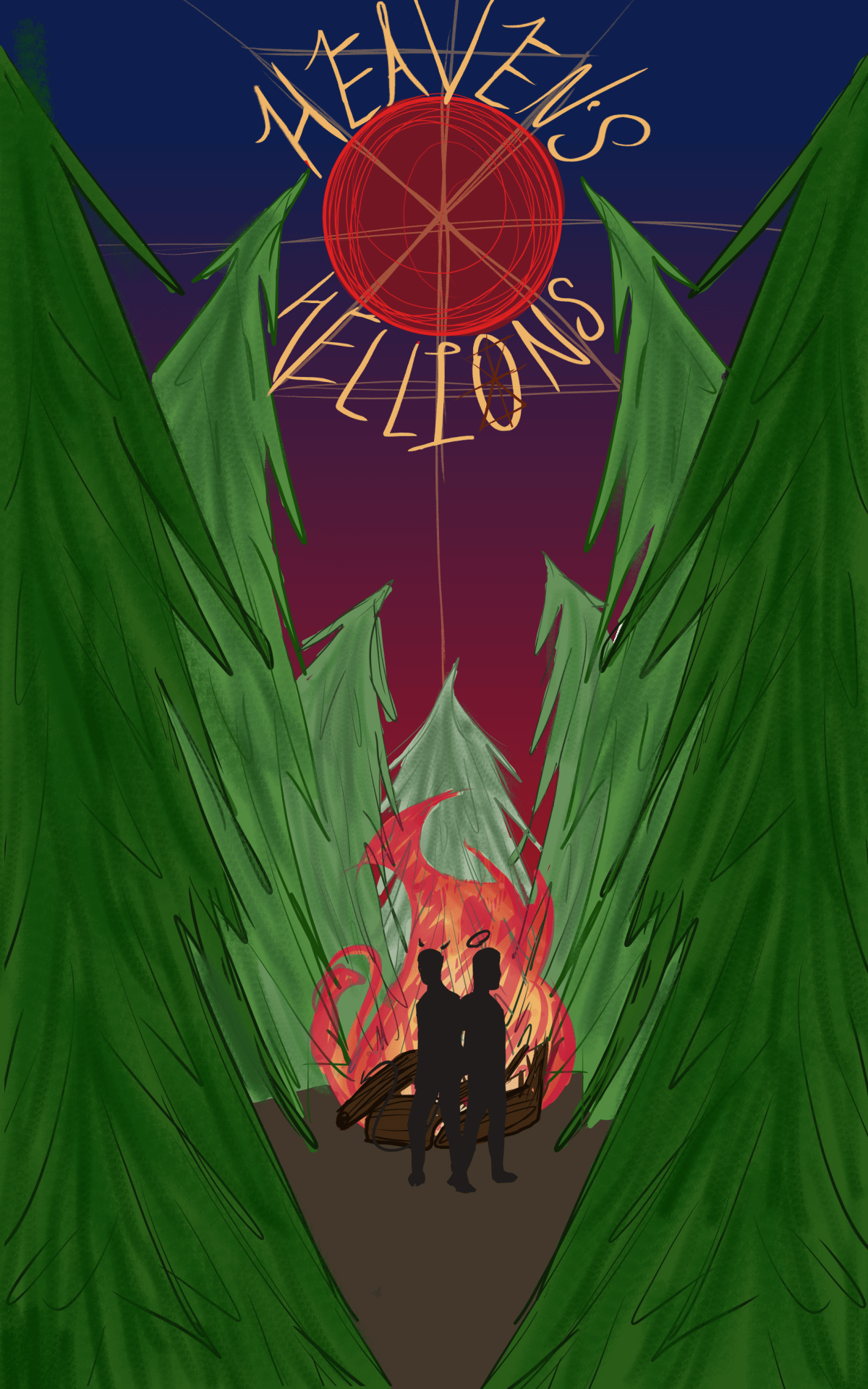
At 12:22 am I wrote the last sentence of my very first book, Heaven’s Hellions. Delirious from working on it for the past four hours, I made many questionable decisions and wrote an ungodly amount of typos. But it’s done.

I wrote my first book and it is over.

Now I want to dissect the experience, tell you what I loved doing and what I hated, ponder my victories and failures, chat about where to go from here.

Stats:

Word count: 51,143

Number of pages: 114

Number of chapters: 27 (not including the prologue)

Started: June 15, 2020

Finished: November 15, 2020

What I thought Heaven’s Hellions was going to be:

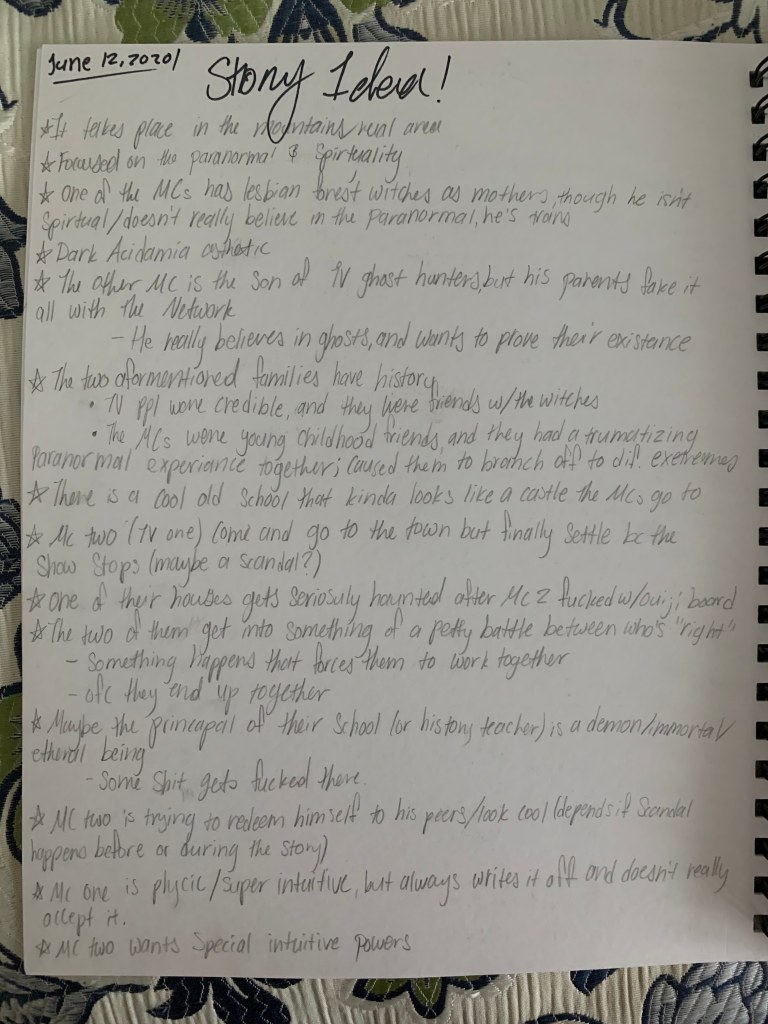
It was supposed to be a paranormal mystery. Everett the Believer would be trying to convince Henry the Skeptic that ghosts exist. In the meantime, both boys get haunted. That’s about as far as I got in the original concept.

Then it divulged into something where Christan mythos would come into play (hence the title of the book). Nothing came of that.

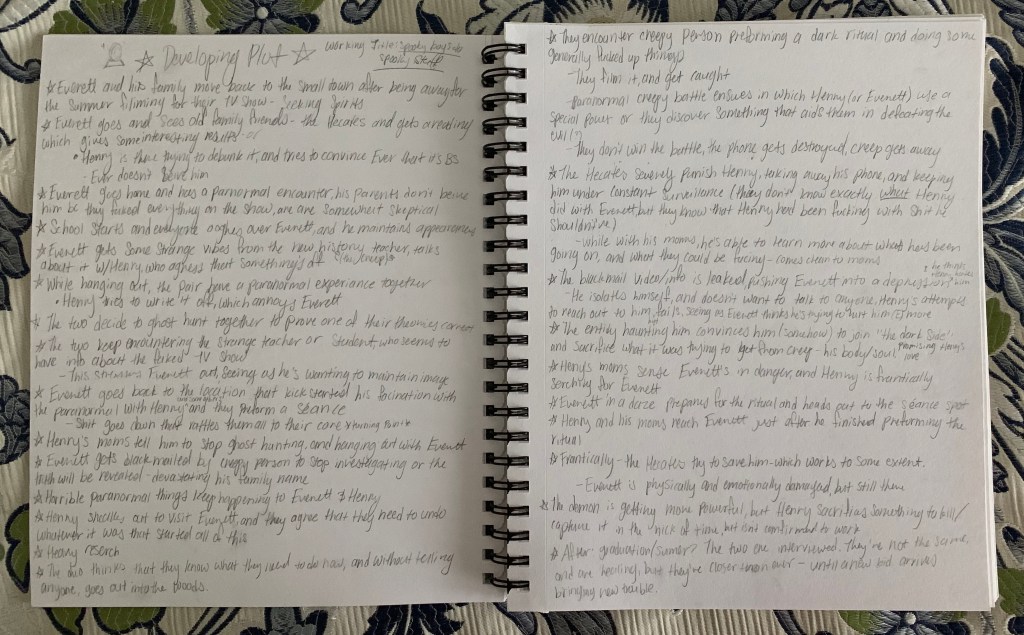
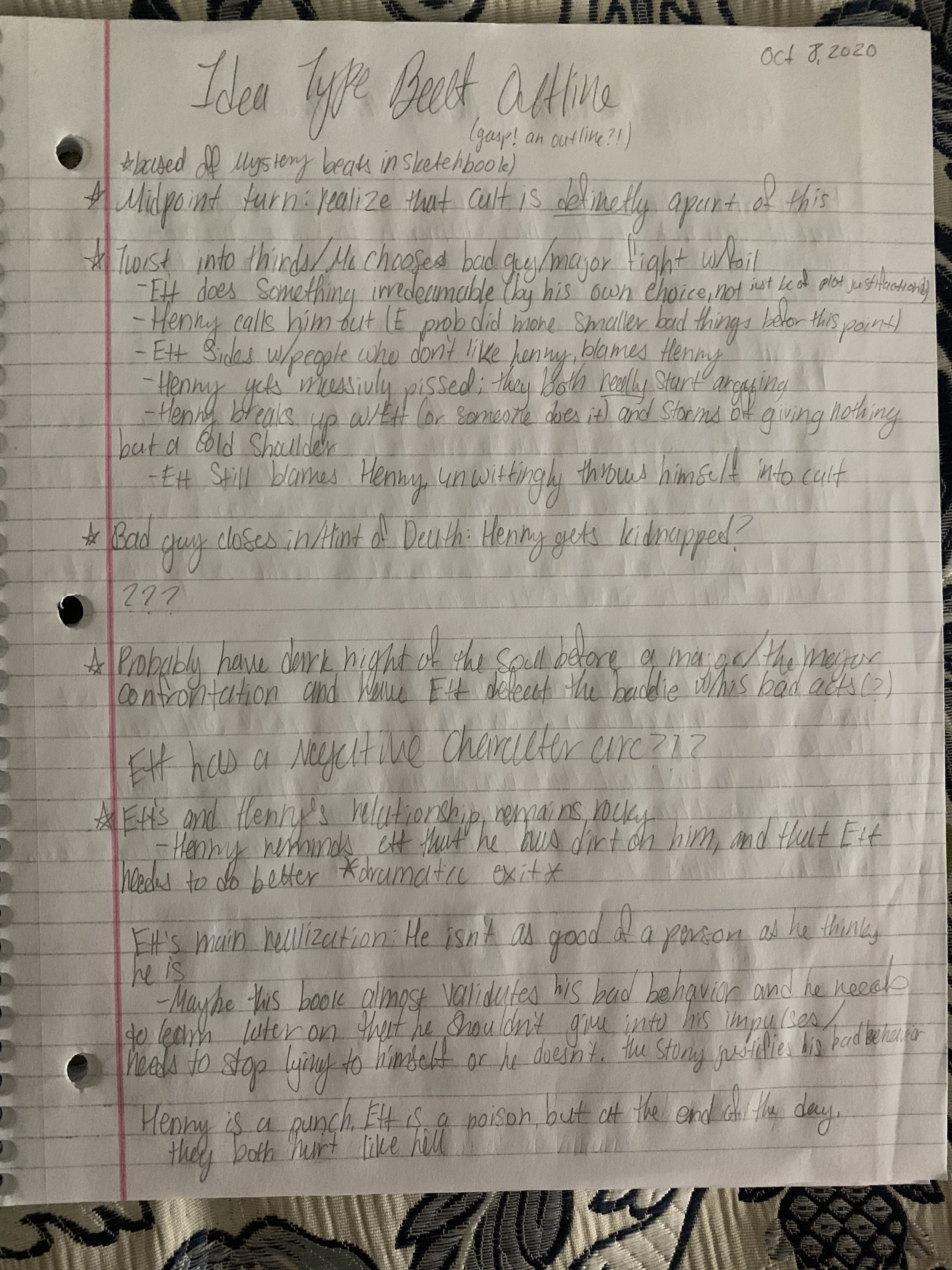
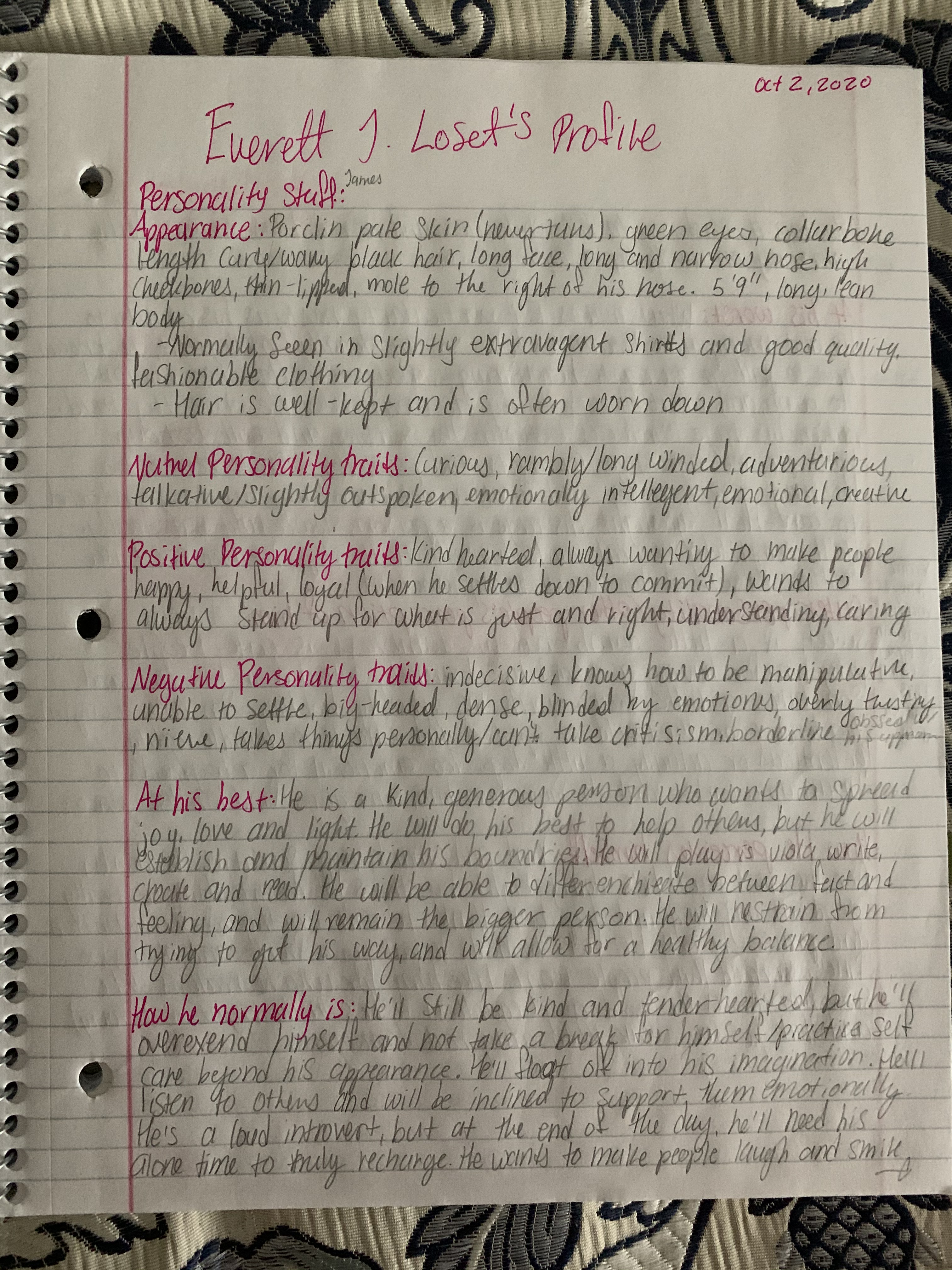
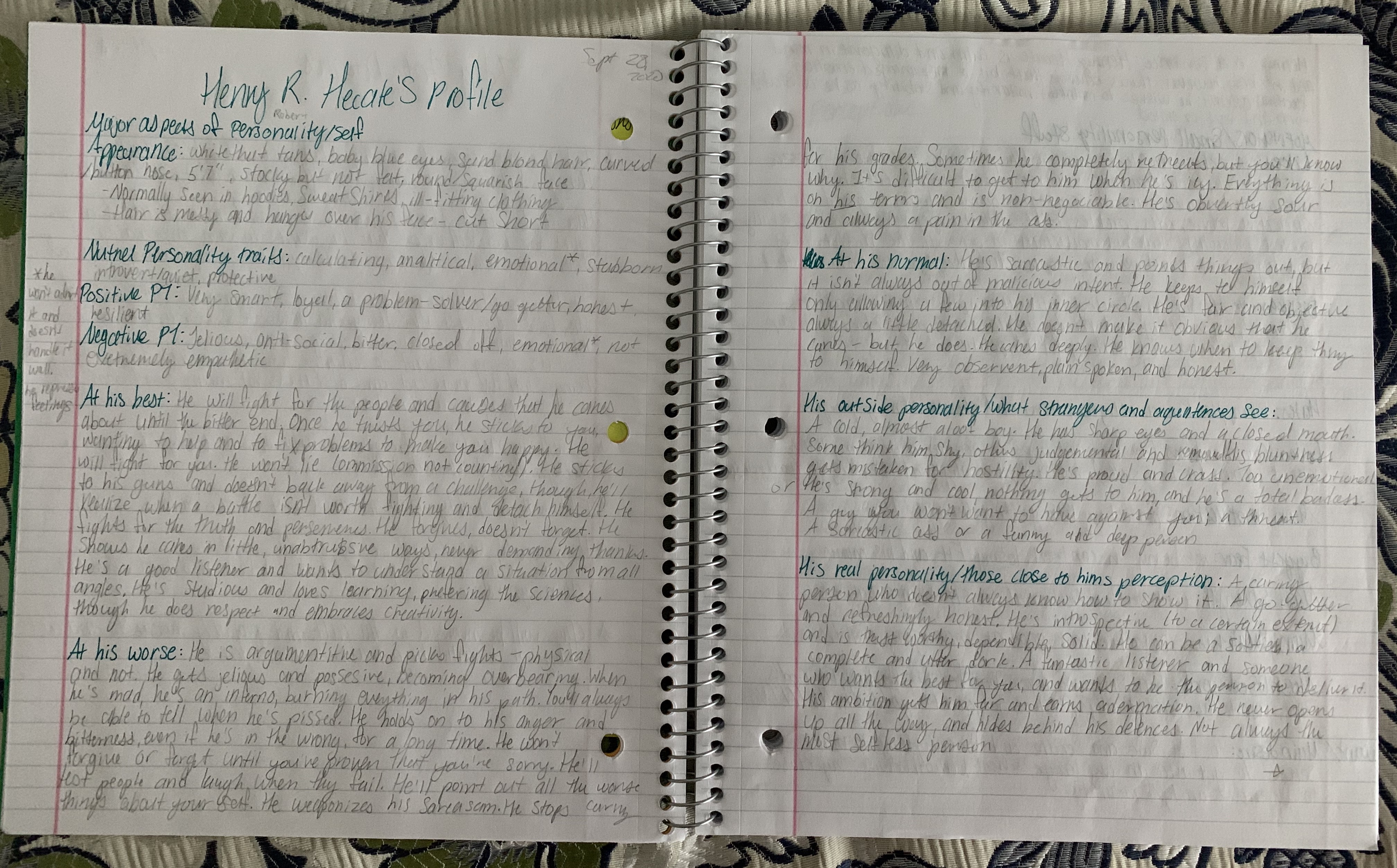
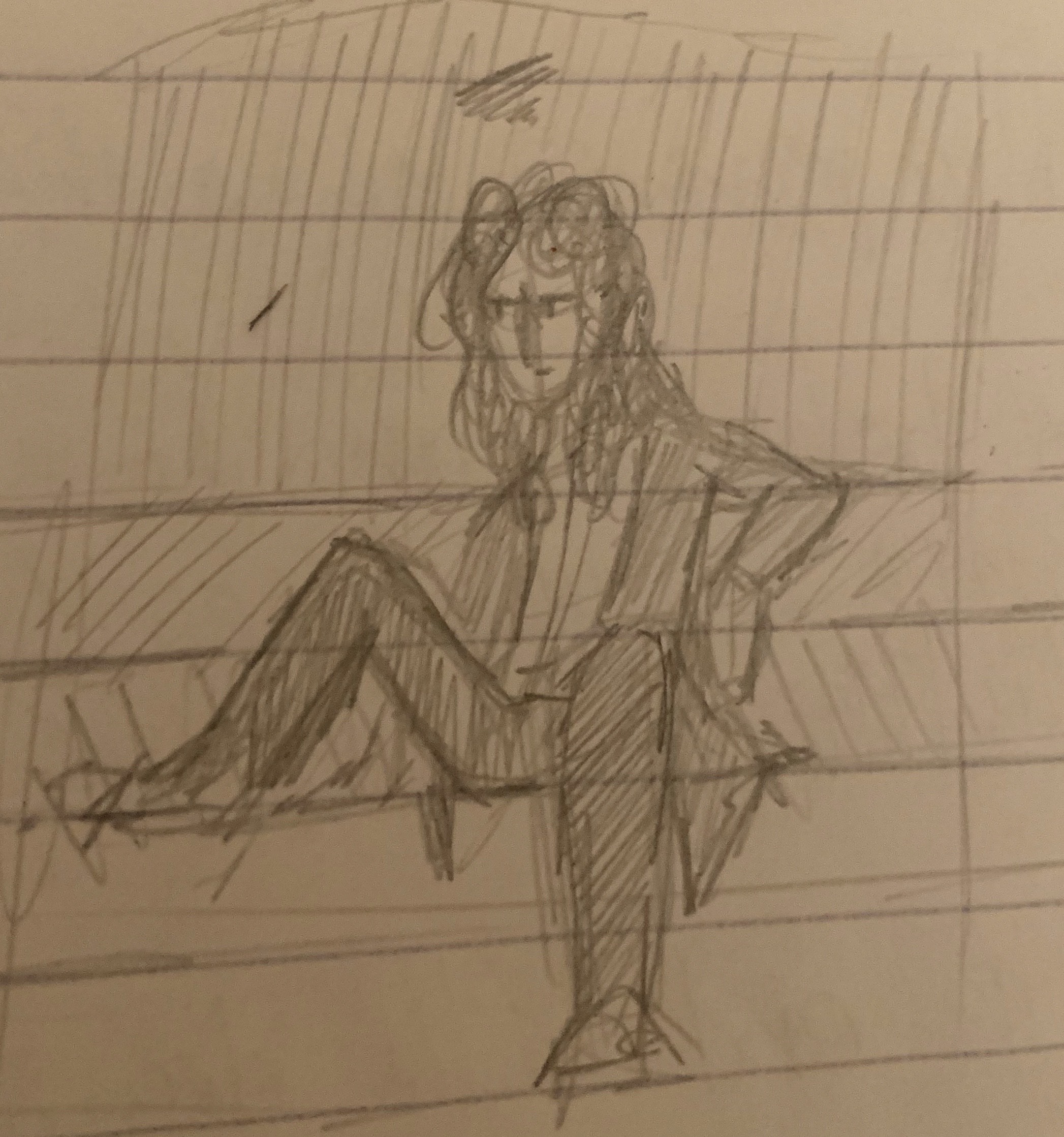
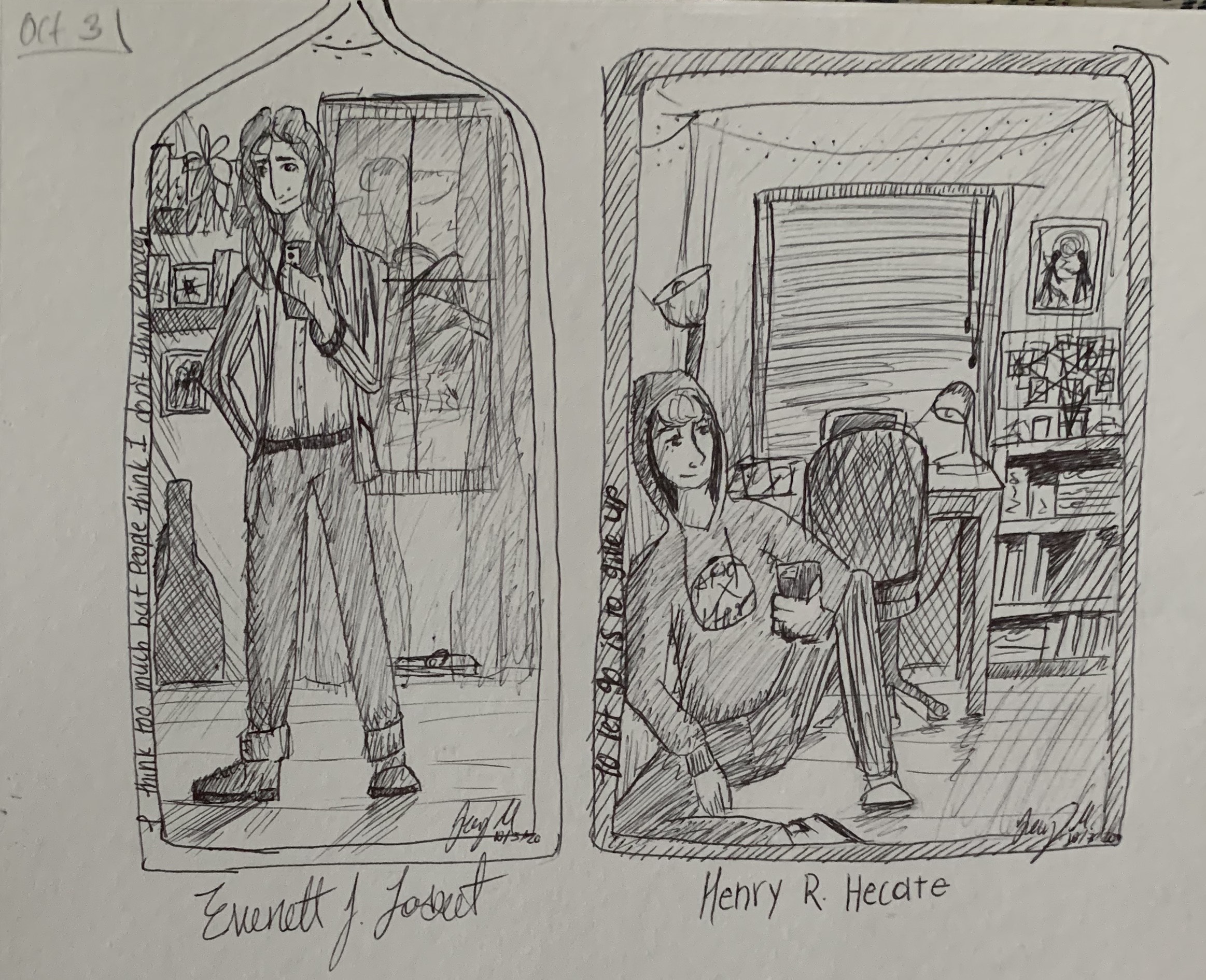
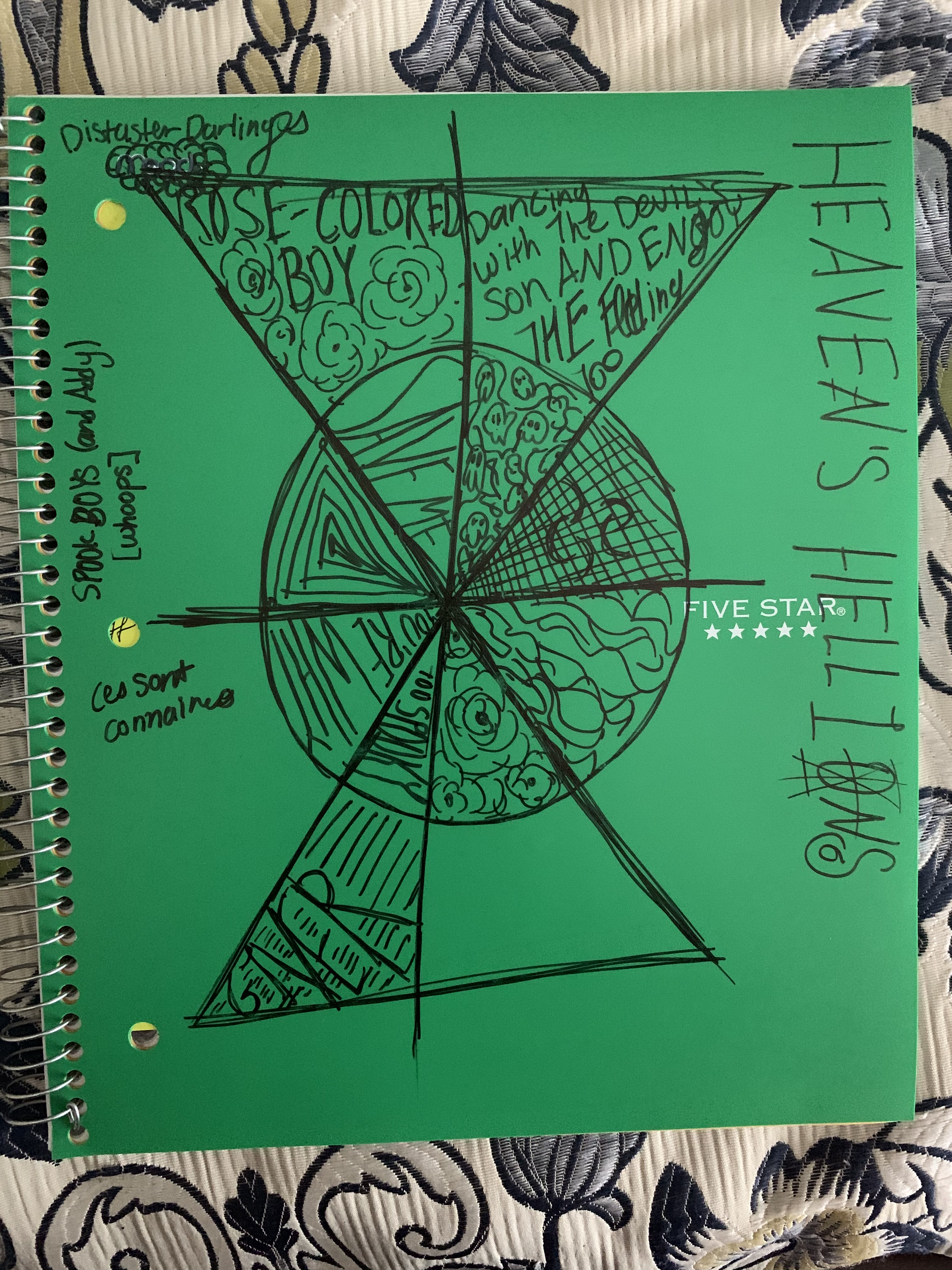
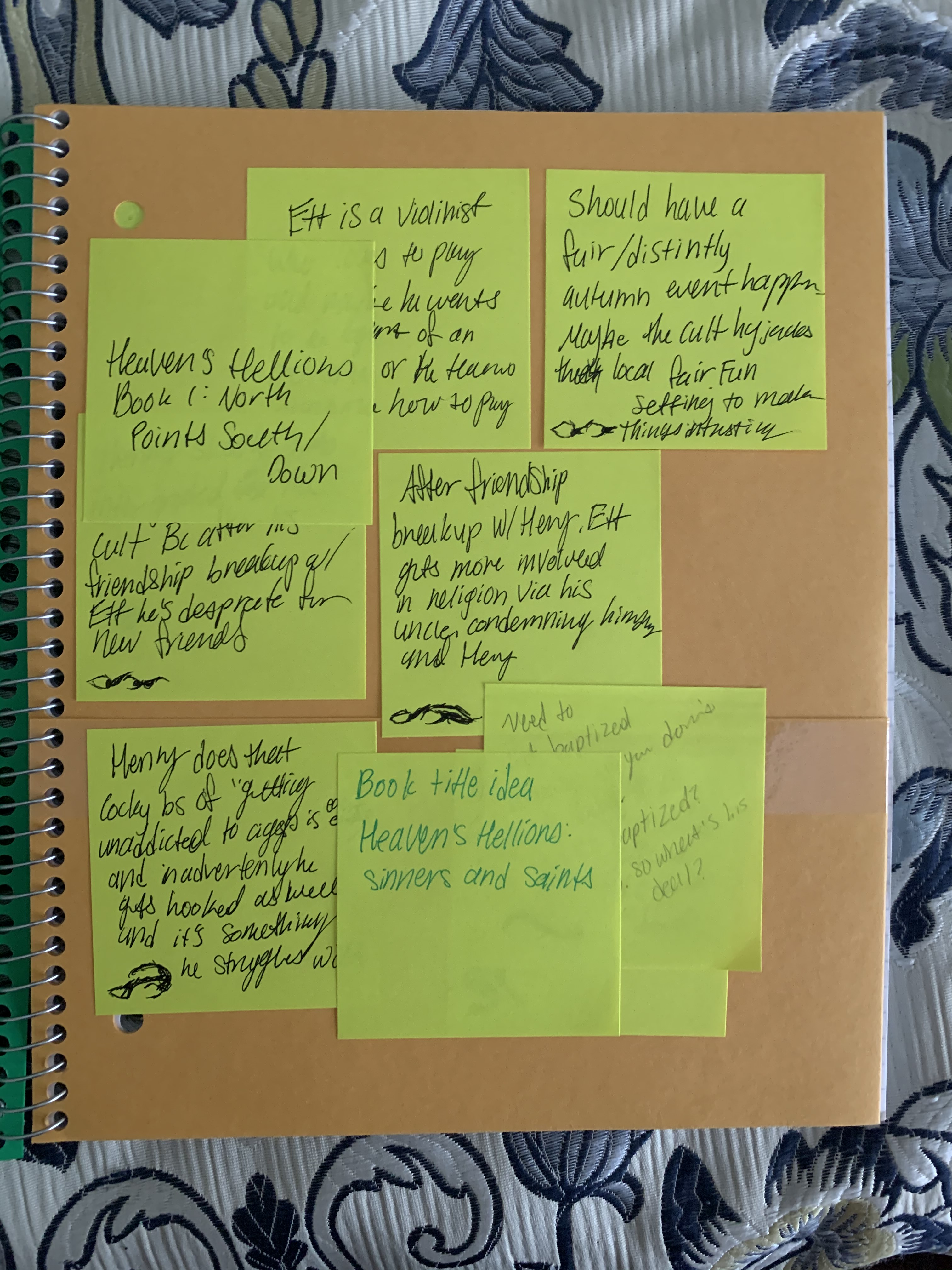
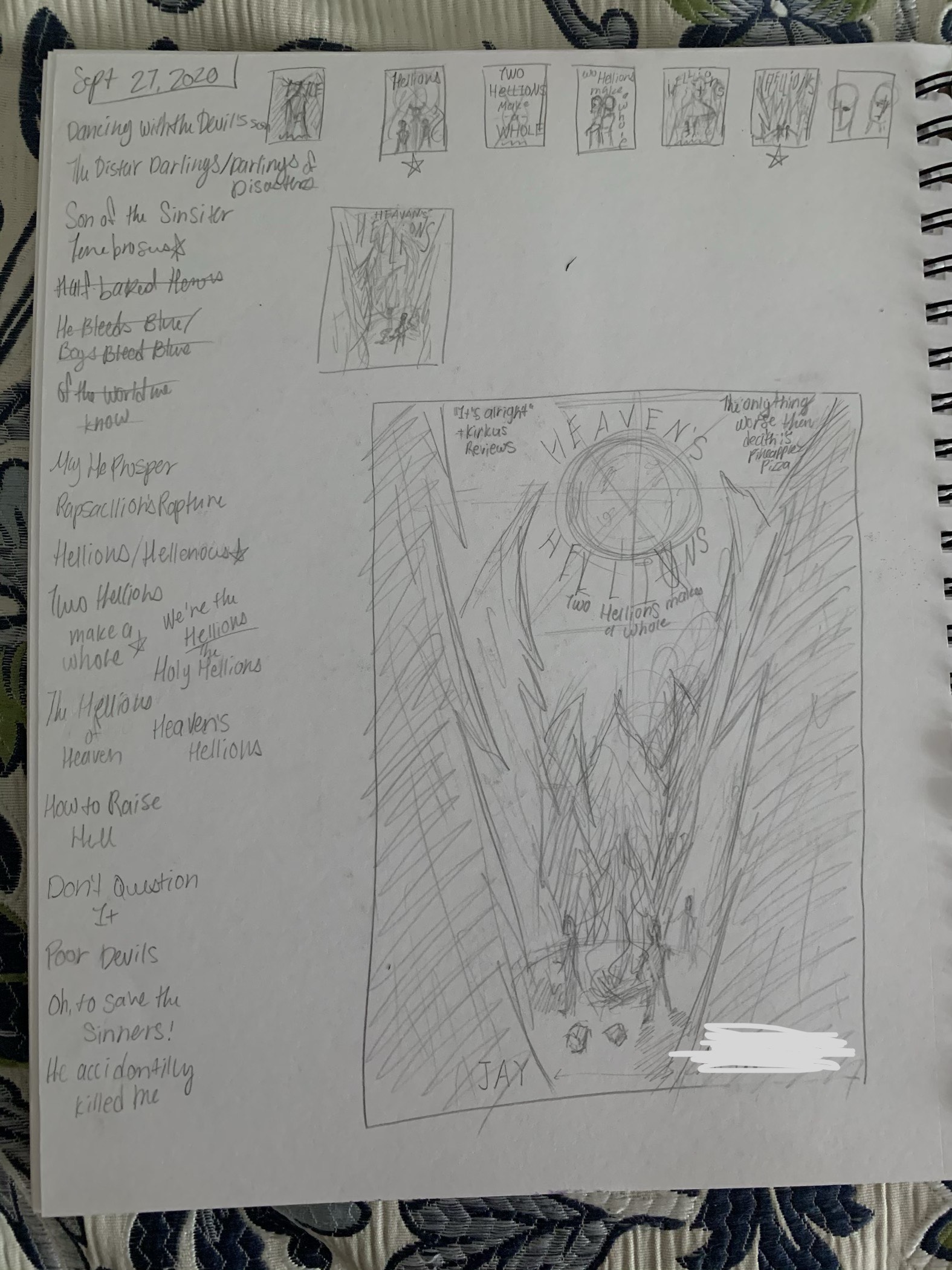
However, I do have the sketchbook that contained all the early brainstorming for Heaven’s Hellions.

This was the first time I write down anything related to Heaven’s Hellions.
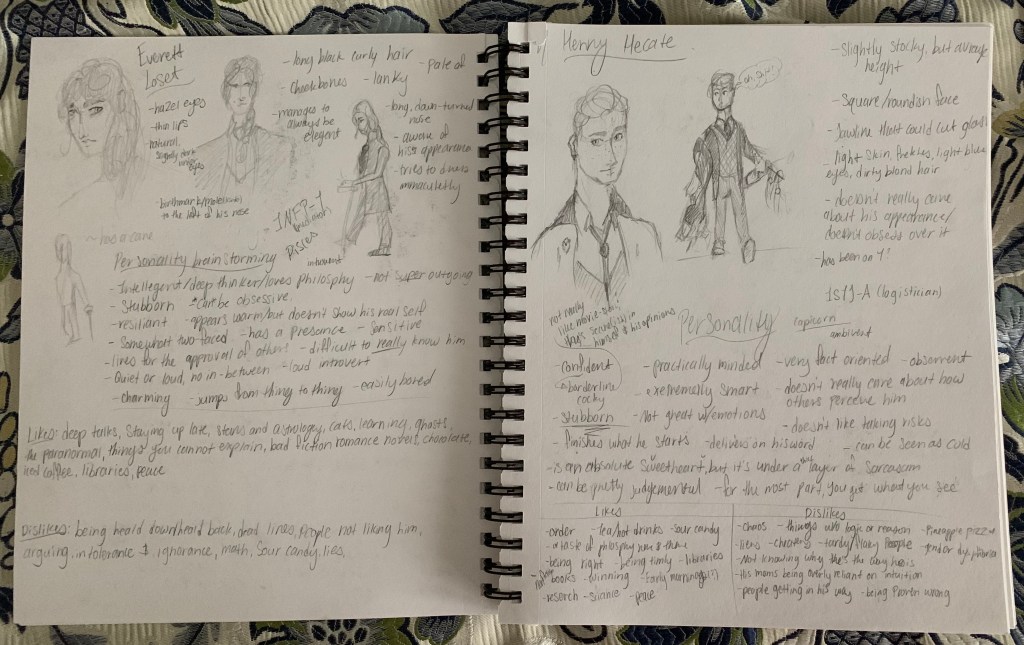
These were the initial character sheets.
Me working on and refining the plot.

We would be here all day if I were to go into all of the little changes that were made to the base concept.

What Heaven’s Hellions turned out to be.

Dark. I didn’t know that I the ability to do that, to hurt characters like that, to put them through some of the worst hardships that anyone can endure. I truly reached into the noir depths of my soul — pockets of darkness I didn’t even know I have.

The gist of the novel (I get to call it that!) is after four teenagers mess with an ouija board in the woods, two of them run away into the cover of the night, one gets possessed, and the last has to pick up what’s left. We follow Henry and Everett, the two that didn’t run off, as they try to figure out what happened to the others, Clay and Addison.

Clay’s body shows up. It’s rumored that Everett was the killer. Out of desperation, he tries to find Addison to clear his name.

The reader watches in horror as Everett keeps flinging himself into more dangerous situations in a desperate attempt to alleviate his guilt. He finally brings Addison home, and while the cheers of the search party bounce off the trees, Everett finds out that his best friend and his father went into the woods to search for him. Three weeks pass and they haven’t returned.

Everett snaps like a toothpick. Sure that he can bring home his loved ones, he goes after them and dreams of a happy ending.

He gets captured by a cult.

Unspeakable things happen to him.

In the end, when he’s face to face with the people he tried to save, he kills himself.

10 things this books has taught me:

1: I am not a planner. At all. 

I tried my hardest to write an outline. I tried a loose outline, I tried an outline that was very detailed, I tried character cards, I tried scene cards. All of that planning suffocated me. When I sat down to write the thoroughly planned draft, nothing felt right and I hated it.

I loved the mystery of not knowing what was going to happen when I sat down and wrote. I let my characters take my hand and pull me through the story.

There were very few things I knew I wanted to implement from the getgo that actually made it.

2: How to motivate myself to write when I didn’t want to

This is something all writers struggle with at some point. This isn’t to say that I never had writer’s block — I most certainly did — but I had to learn what was me not being motivated and what was me genuinely having problems with my story, and how to deal with each accordingly.

3: How to write a book (wow really? No way.)

I had to adopt this “eh, fuck it” mentality that allowed me to make mistakes, write awful scenes, and some of the worst prose I have ever laid eyes on (I’ll get to that in a second). I had to learn to let go of making this book flow, having it be pretty, hell, having it be readable. I had to constantly remind myself that not only is this the first draft of a book, it’s the first draft of my first book, ever. Just let it be bad. And this is a mentality I adopted fairly early on which is what allowed me to write a book in five months.

4: I’m a character person through and through

I kept writing because I wanted to be with my characters. I wanted to see what they would do next, I wanted to write them interacting and doing things. They are what kept me going when I wanted to quit.

5: Don’t share first drafts

This is the first book I didn’t share the first draft of with my friends, and it’s the first book I’ve completed. Sharing those first drafts puts eyes on the most vulnerable stage of my work, and it placed unnecessary pressure on me to make it flow. Not having people see it gave me the space I needed to make Heaven’s Hellions exist.

6: I need to vent my writing somehow

Shout out to one of my closest friends Emily for having to put up with my constant writing rambles. I would send her monstrous texts talking about something going on with the characters, or scenarios that could happen, or ideas I wanted feedback on. And while she was extremely encouraging, she was never afraid to give tough love.

Thank you, Emily, you mean the world to me and this book wouldn’t exist without your support.

7: My plot bunnies mutate

A plot bunny is another idea for a completely different story. For example, you could be working on a fantasy novel but you get the idea for a contemporary romance instead. Plot bunnies become problems when you start chasing them instead of finishing your current project.

Because I grow so attached to my characters, I can’t stand to let them go. So, when I get a new idea for a seemingly completely different story, I just pick them up and drop them into that narrative. It’s not pretty and it muddies up my mind and my draft.

8: I’m not good at implementing preexisting ideas

When I go for my walks, I get tons of ideas for my stories. In fact, I was planning on having Everett be the son of Satan (among other plot ideas) that never got woven in.

When I sit down to write, I reread what I wrote, then I go from there; I improvise. So all that I had planned gets left out and sulks at the edge of my project.

9: I really enjoy breaking formatting

I love having words float around on a page, make sentences run on, or mash sentences together. Towards the end of the book, I used a lot of filtering to show how my character no longer feels in tune with himself. It’s so much fun to alter the style of the prose to fit in with and extenuate the character’s state of mind.

10: How to make first-person POV work

Does that make me sound conceited? I love first-person POV, but I knew that already. I learned how to make first-person, well, personal. I learned how to keep filtering to a minimum, and when used, make it feel authentic. Now, authentic to Ett or myself has yet to be determined. I wouldn’t say I’m the best at it, but writing 51k words in a certain POV is bound to teach me something.

What I’m good and bad at

That header was a lie; I can’t tell what I’m good and bad at. I’m so close to my work and I have just finished it, I can’t objectively tell what I succeeded and failed at. This isn’t to say that I think I was good at everything I attempted, or that I bombed everything at every turn. I simply don’t know. So, in a few months, I’ll make a more in-depth post about what I did right and wrong in my first novel. Stay tuned.

My favorite parts:

Here are some of my all-time favorite quotes of the book (I feel weird saying that I have favorite quotes in my own damn novel). 

For context, this is when Everett and Henry are looking in the woods with a search party for Addison.

“Do you think she’ll be found alive?” Henry asks, his voice barely trumping the whisper of wind in the trees.

Of course she’ll be found alive.” I say.

“Then why haven’t we been calling her name?”

I also love the last two lines, edgy as they may be. But they’re indicative of the negative character arcs I tried to implement into the novel (let me have my angst):

“I soak in the boy I used to know; I pretend I push up his glasses, and I imagine that he tells a joke.

I laugh as I put the gun to my temple and pull the trigger.” 

For much of the book I was torn about whether I should give Ett a negative character arc or not; to keep him as a harmless little lamb or a wolf parading around as a doting sheep. I think I ended up somewhere in the middle.

It was so much fun to write him gaslighting people, lying, convincing himself that he was doing the right thing, among other things. It was exhilarating to write an almost unwittingly manipulative person, to learn about how manipulation works, and to explore the complexities of abuse cycles. I’m not saying I did it well, or that it was effective — I have no clue, but I tried.

I didn’t write any romance and I’m glad I didn’t. Heaven’s Hellions also touched on toxic friendships; Henry and Ett were overly reliant on one another. It wasn’t just that they bickered badly or that they were mean. I wanted to explore codependence and resentment. I wanted to write people that were so afraid to let go that they practically killed themselves and others.

My least favorite parts:

There are so many. My god. I know for a fact this book has tonal and pacing issues. There aren’t enough characters and only two were actually developed. There are plot holes the size of the Grand Canyon. Again, I can’t say what they all are because I’m too close to it right now.

Many of the mistakes I’ve made are the typical novice pitfalls. Either way, when I can, I’ll look back over Heaven’s Hellions and figure out what I can improve upon going forward. 

Here are some of the worst lines:

“He chuckles, and I move right along with every movement of his.”

“My limbs are too heavy to lift. They drop to my side as the light now burst in complete darkness.”

I’m sure there are so, so many more, but I don’t feel like mining for them. Trust me, they’re there.

Now what?

I’m not going to edit or revise Heaven’s Hellions any time soon. There is too much that needs to be done, and frankly, I’m tired of working on this book. I’m glad it’s over with. I need to move on to something different, something happier. But that isn’t to say that I won’t ever return to this project. I think that when I’m older, when I have a better grasp on characters, plot and plot structure, and how to write emotionally charged scenes effectively, I’ll give this another shot.

I’m planning on working on a project that’s a fluffy, cute, romance that I will try to push into a further phase of development. This new book is something that I want to revise, I want to edit, I want for people to actually read. Not sure if I’ll publish it or not, but I do know that I want critiques on my long-form work. I want this new project to be something that I’m proud of beyond it just existing.

Because I now know that I don’t like outlining, that I’m reliant on characters and that I may go to the very darkest corners of the universe for conflict, I need to plan for that. I still need to do so much brainstorming for this new book and frankly, I’m not quite ready to jump into another long-form project just yet. 

I don’t know if I’m going to keep Everett and Henry and transfer them to a new world (not the romance project). I have the idea for a steampunk paranormal adventure, but I need to do a ton of research for that project. A ton. And it’s sad to say, but this may be the end of the characters I have been with for so long.

I’m going to work on short stories. I’m not burned out, exactly, but I definitely need to recalibrate so I don’t spit out the same thing again. I need to get passionate about my new world and characters, I need to get familiar with them. I want to work on this new website, write different stories, do more beta reading, and try things I haven’t been able to because I was so consumed with Heaven’s Hellions.


Thank yous

Thank you, Heaven’s Hellions, for being my first book. Thank you for all that you’ve taught me. Thank you for your adventures. Thank you for giving me something to latch onto while the world explodes around me. Thank you for giving me a reason to continue through some of my darkest times this year.

Thank you Henry for being the less confusing of the two; for being reliable, sarcastic, and bringing balance. Thank you, Everett for being so loose, for allowing me to project my deepest fears and the darkest parts of my soul onto you. Thank you Clay for being my first fictional dead body, and Addison, my first massive twist. 

Thank you Emily for always being there and telling me the shit I needed to hear.

Thank you Google Docs for being available offline.

Thank you spell checkers.

Thank you to all the random authors who give writing advice on YouTube; you’ve taught me so much and provided me with endless entertainment.

And finally, thank you, dear reader, for getting to this point. I hope that you have faith in me, my writing, and my future endeavors.

~Jay

Categories
Personal Rambles

Here’s to Hoping My Lack of Motivation Won’t Kill My Novel

I mean, the title says it all. I’m sure that in the history of everything, I am the only person to have ever struggled with motivation, and more specifically, the motivation to write. What can I say, I’m just that important.

It’s an odd feeling for a number of reasons. This past summer I was so fired up for this book, the setting, the mystery, the characters… but now the “oh, shiny” syndrome has taken over, and my poor little work in progress is as dull as carpet.

Here’s the thing about my plot bunnies; they don’t reproduce as in I get completely new ideas, nay, they mutate. I’m far too attached to my characters to ditch them like a frat boy to his girlfriend in a movie, so I just drag the poor things along, trying to find them an adequate home.

What I’m saying is that a story set in a paranormal reality akin to ours is tipping into steampunk territory. No, I don’t feel like explaining that jump to you, my dear reader. Well, okay, to be frank, I don’t even know how I made that jump (pogo stick on steroids, perhaps?).

My current WIP is an odd little child of mine that’s wandering about, bumping into things, and getting lost in closets. Maybe having it walking around gives it too much credit… that implies that it works.

It’s probably not an utterly fantastic thing that I’m falling asleep before writing the climax of this atrocity. Whoops.

It’s never seeing the light of day. Or night for that matter. Hell, it shouldn’t even see the light of my computer screen.

Don’t get me wrong (yes, I’m quite aware it’s easy to do that), I still care for it. It’s the first time I’ve ever gotten so far into a project like this (46k words) and it seems like such a shame to drop it now. I just need to kick my own ass, and get the damn thing over with.

My current strategy is to tempt myself with working on The New Thing™, but I can’t work on The New Thing™ until the Old Thing is done.

Still, it stings that I won’t really do anything with this first draft, ever. It will always be the first book I wrote; I guess that’s all it ever needs to be. I’ll bookmark the zingers of lines, I’ll take note of what worked and what didn’t, and I’ll be proud of myself for getting this far.

How have you wrangled with lacking motivation to write? Do you punch your indolent bum and force yourself to work, or are you brave enough to admit that you don’t? When do you think it’s fair to give up on a project?

Thanks for reading, friend. Until next time, don’t kill anybody and don’t die.

~Jay

2020-12-31T23:59:00

  days

  hours  minutes  seconds

until

Until I should Have My Current WIP Done

Categories
Short Fiction Spooky

Little Lamb

So you have come again, little lamb? Tell me, where is your family? Your shepherd, your herd? You come so very alone, little lamb. You stomp through the forest like it’s yours, you gaze upon the trees like they’ll sing, you humm a tuneless tune to keep the shadows at bay.

I know what’s underneath your layers of clothing, under you skin and you muscles, I know what makes up your brittle, broken bones. Oh little lamb, turn back now my sweet. They’re searching for you. Of course you don’t hear them calling your name. You never listened before, so why listen now?

You’re going to save them, are you? You’re going to walk into my land and take back what was never yours, little lamb? Tell me, are you going to keep the screams that ripped out of their raw throats? You can have them; they’re still echoing around in the frosty air.

They won’t come to your calls, little lamb. They never could. They’re rotting into the soil as we speak. Their fluids are making the leaves underneath them soggy, the buzzards are pecking out their eyes, the wolves have ravaged their flesh. You’ll smell them before you could ever see them. Your stomach will twist into knots, you’ll go pale, you’ll have to lean up against one of my trees as you spew out your guts. I’m sure the maggots will be twisting and crawling around in their skulls. What good treats they make!

Oh little lamb, I cannot wait for you to fall. How long will it take you, hm? A week, a month, maybe three? Watch as the night grows closer, how the moon hides behind her clouds. Listen as my forest stills around you, as the leaves stop whispering in the highest branches, as a brave owl hoots — mocking your name. You’ll stumble around for shelter, hugging your thinning arms about you, shivering, chattering, wasting water with hopeless tears.

There’s nothing in the sky that wants to smile down on you, for there’s only the insatiable hunger of all that hides. They will eat you as they have eaten the ones that you love.

What now little lamb? You lay on the earth in a ball, still. But you breathe. You are nothing more than the dirt you lie upon. That’s the problem with creatures like you, always taking more, chipping away at me and what I am, for your own benefit. What of your mother? Will she follow you like your father did?

They would still be alive if it weren’t for you, little lamb. You would still be able to to have their warm arms wrapped around you, their soft words being whispered into your ears, you would be full, your cheeks rosy, you smile wide. But no. You had to take.

Now you watch as snow settles down onto your stiff body. You don’t have the energy to shiver anymore. Your blood is thick as sap as it settles. Ice snakes up your face, holding it like a mother would hold her newborn. Your heart is laying down to rest — the last thing to go.

It’s too late for you have killed another, little lamb.